You grab the sponge, swipe, rinse, squeeze, toss it back beside the faucet. There’s a faint, sour note you pretend you didn’t smell. Later, you wipe a cutting board, then a toddler’s tray, then a splash on the fridge handle. The sponge is the household’s little diplomat, shuttling from surface to surface, making things look clean. Looks are persuasive. Microbes don’t care. They count time. And their timeline is faster than ours. One small swap, on a strict clock, changes everything. Seven days makes all the difference.
The 7-day tipping point

A kitchen sponge is paradise for microbes: porous, always damp, flecked with food, and usually lukewarm. Bacteria latch on within hours and start building a biofilm, that slim protective layer you can’t see. Day by day, the sponge shifts from “fresh” to “colonized.” By the end of a week, the community is organized and resilient. That’s when it becomes a spreader, not just a cleaner. Replace it before that maturation step, and you cut the network before it hardens. **Replace your sponge every seven days. Full stop.**
Think of a weeknight after tacos: a little beef juice here, a smear of avocado there, drops of rinse water in between. We’ve all had that moment when the sponge does a tour of the kitchen like a busy bee. In home swab tests I’ve seen, ATP readings drift upward around day four, then jump around days six to seven. Larger studies have found sponges among the germiest items in a home, often showing coliforms and yeast. That late-week spike is the difference between wiping mess and spreading it.
Why seven days and not three or twenty-one? Early days bring fast growth, but the community is fragile and easier to knock back with hot water and soap. By roughly a week, the biofilm’s glue—the extracellular matrix—thickens, and hardier species take the lead. Some bacteria ride along in microscopic water left in the pores, hitching from counter to cutting board. Swap at day seven and you step in right before the biofilm matures into a stubborn, broadcasting layer. *It’s a tiny change with an outsized effect.*
How to make the 7-day rule effortless

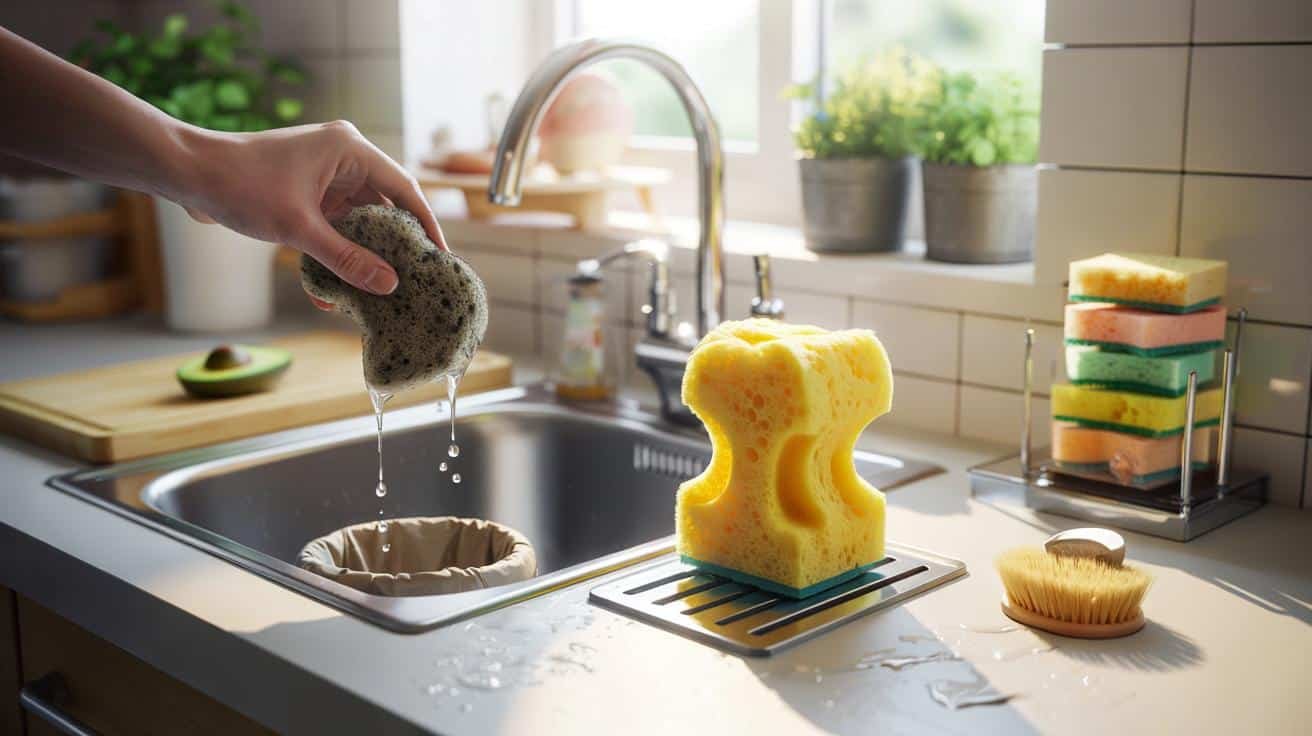
Pick a day and make it your sponge day. Monday works, or the day your trash goes out. Keep a sleeve of sponges under the sink and drop a sticky note on the calendar: “New sponge.” If you love visual cues, buy two colors—blue for week one, green for week two—and alternate. Store the sponge on a dry, ventilated rack, not a dish of standing water. Rinse it hot, wring it hard, let it breathe. The simple combo—drying daily, replacing weekly—does more than most fancy hacks.
A few easy guardrails help. Use a separate sponge or a disposable towel for raw meat juices so you’re not seeding the main sponge with trouble. Skip soaking sponges overnight in heavy bleach baths; it breaks them down and doesn’t fix the biofilm problem long-term. Dishwashers with a hot cycle can reduce the load, but that’s a stopgap between swaps, not a pass to keep a month-old sponge. Let’s be honest: nobody does that every day. **Smell is not a reliable safety check.** If it’s slimy or musty, it’s already late.
Think in rituals, not rules. Tie your swap to something you already do, like Sunday meal prep or payday. Two minutes, in and out, done. Your future self will thank you during a busy weeknight rush.
“Sponges aren’t villains—they’re tools. The trick is to retire them before the microbial community gets organized,” a food microbiologist told me. “Seven days keeps you ahead of the biofilm.”

- The one-week playbook: rinse hot, wring dry, air between uses.
- Color-code tasks: one sponge for dishes, another for counters.
- Swap every seven days, no extensions, no debates.
- Use paper towels for raw-meat spills, then clean the surface.
Rethinking the humble sponge
We ask a tiny square of foam to do a lot. It’s quick, it’s easy, it’s always there. When you put a seven-day cap on that job, you’re not just being neat. You’re designing your kitchen for fewer chances, fewer leaps from sponge to sink to salad bowl. The best part is how effortless it becomes once it’s a rhythm. You don’t have to be perfect. You just have to be predictable. A fresh sponge every week is predictability you can feel. People notice their counters smell cleaner. Meals feel calmer. And conversations at the table get to be about the good stuff again. New recipes. The day. Not the mystery smell next to the faucet.
| Point clé | Détail | Intérêt pour le lecteur |
|---|---|---|
| Replace every 7 days | Swap sponges on a fixed weekly schedule | Cuts biofilm before it matures and spreads |
| Dry between uses | Rinse hot, wring hard, store on a vented rack | Slows growth and reduces cross-contamination risk |
| Separate tasks | Color-code or dedicate sponges; avoid raw-meat cleanup | Stops high-risk bacteria from moving around the kitchen |
FAQ :
- How often should I replace a kitchen sponge?Every seven days for regular home use. Heavy cooking or frequent raw-meat handling may warrant twice-weekly swaps.
- Can I microwave a sponge to sanitize it?Microwaving has mixed results and carries burn/fire risks if the sponge isn’t fully soaked. A hot dishwasher cycle helps, but still treat it as a bridge to the weekly replacement.
li>Are brushes safer than sponges?Dish brushes dry faster and harbor fewer microbes between uses. They’re great for scrubbing, with a small sponge reserved for wiping and replaced weekly.
- My sponge doesn’t smell—do I still need to replace it?Yes. Odor shows up late. Bacterial communities can be high before any smell kicks in.
- What’s the best way to store a sponge?Keep it upright on a ventilated holder, not in a puddle or the sink. Air and quick drying are your friends.