This sounds harmless: you crack open a package of chicken, give it a quick rinse under the tap, and feel cleaner for it. Food safety experts say that tiny habit is the problem—here’s what to do instead.
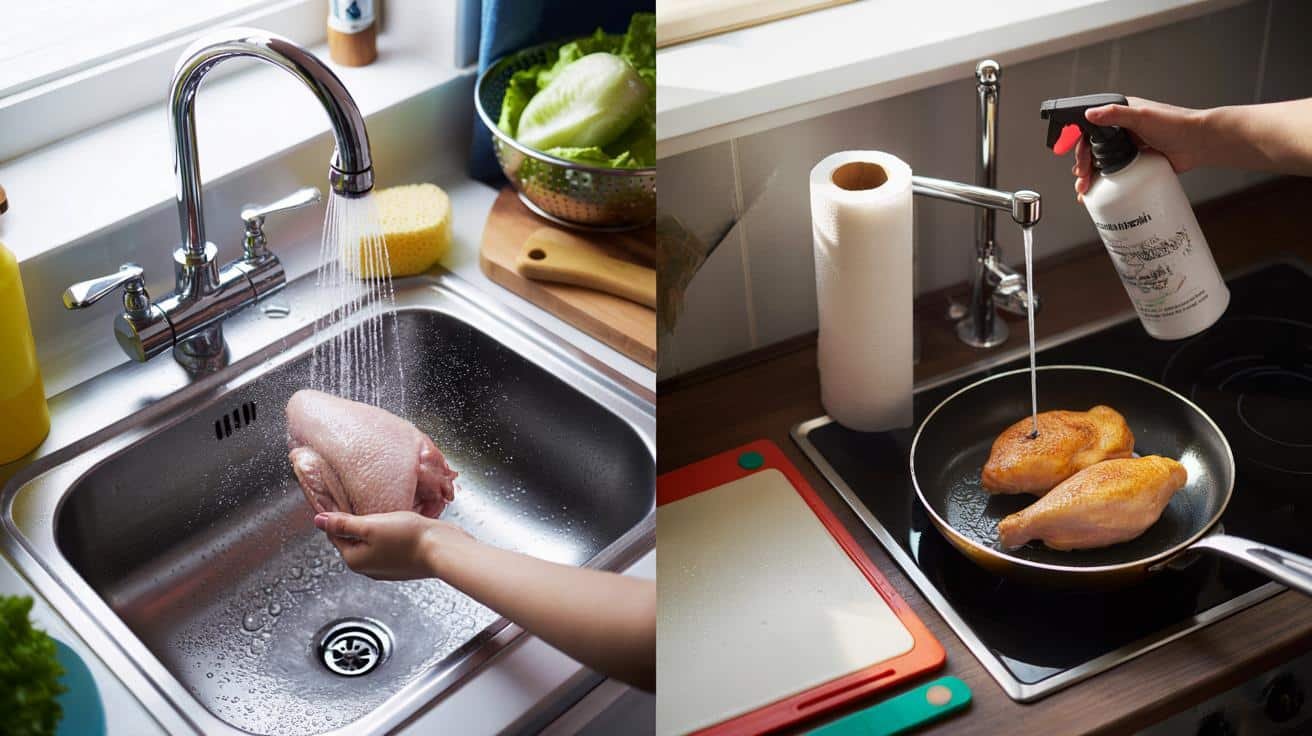
A home cook angles the chicken under a bright stream, glancing at the clock, the dog, a buzzing phone, while droplets flick off the metal faucet like glitter. Water splashes the sink walls, the cutting board, the sponge you’ll use later on the counter, and then the package edges as you fold them into the trash. The kitchen looks the same after, maybe a little shinier, maybe a little better. *I can still hear the faucet roaring long after the water’s off.*

We’ve all had that moment when routine feels like safety. When the rinse is a ritual, not a risk. The splash is the story.
Stop rinsing raw chicken: the invisible mess you don’t see
Stop rinsing raw chicken in the sink. It doesn’t “clean” the meat—it spreads microscopic bacteria around your kitchen in a fine mist you can’t see. Studies from food safety agencies have shown that splashes from raw poultry can travel up to 50 centimeters from the faucet, seeding sinks, surrounding counters, and anything parked nearby with Salmonella or Campylobacter.
In controlled kitchen tests, researchers watched perfectly clean sinks become contaminated in one routine rinse, then watched transfer happen again when people set a colander down, touched a sponge, or washed lettuce in the same basin. In one USDA–NC State observation, a majority of participants who rinsed poultry contaminated the sink, and many unknowingly carried those microbes to salads or ready-to-eat foods. The chicken looked fresher after its shower. The kitchen wasn’t.

Why does this happen? Because water pressure breaks particles loose and throws them outward, and bacteria don’t politely stay put. Your eyes can’t track aerosolized droplets, and your sense of “clean” leans heavily on shine, not microbiology. Heat, not water, removes risk. Cooking chicken to 165°F (74°C) knocks out pathogens; a faucet never reaches that temperature, and running water can drive microbes into nooks of the sink where a quick wipe won’t touch them. Clean doesn’t always look clean.
What to do instead: a safer, quicker routine that actually works
The safest move is simple: move it from package to pan without a detour to the faucet. Open the package near the stove, let any juices fall straight into the tray, and drop the chicken into a hot pan or onto a lined baking sheet. If a recipe begs for dry skin, pat with disposable paper towels only, then toss them immediately and wash your hands with soap for 20 seconds.
Cook to 165°F (74°C) in the thickest part; a small digital thermometer is your best friend here. Let’s be honest: nobody actually does that every day, but the moment you try one, you won’t go back—the guesswork disappears. Keep raw poultry tools separate: one cutting board for raw proteins, another for produce. If juices splash, clean the area, then sanitize the sink and faucet with a kitchen-safe disinfectant or a mild bleach solution, letting it sit for the contact time on the label.

Common mistakes? Reusing marinade or rinsing after brining, resting chicken on the same plate that held it raw, or “just rinsing off the slime” to fix a funky smell. If it smells off, don’t eat it; water won’t fix spoilage.
“Water doesn’t make chicken safer—cooking does. Rinsing only spreads contamination you won’t notice until someone gets sick,” said a food safety researcher we spoke with.
Try this quick mental checklist the next time you reach for the tap:
- From package to pan: no sink detour.
- Thermometer to 165°F (74°C): verify, don’t guess.
- Separate boards and knives: raw proteins vs. produce.
- Sanitize sink and faucet after handling raw chicken.
- Never reuse marinade on cooked food.
The bigger shift: less fuss, more real safety
There’s a quiet relief in dropping an old habit. You skip the rinse, you skip the splatter, and you skip the ritual of scrubbing every nearby surface you didn’t know you hit. The new routine looks like this: open, transfer, cook, verify, clean once with purpose. It saves water, time, and a headache you’ll never see but will definitely feel if someone lands a stomach bug.
Rinsing made sense in our heads because clean has always meant “washed.” But kitchen safety is more about flow—how food moves through your space, how your hands move from package to handle to phone, how a splash becomes a smear on a towel you later use on a bowl of salad. The fix is almost boring, which is why it works. Keep the drama on the plate, not in your plumbing.
| Point clé | Détail | Intérêt pour le lecteur |
|---|---|---|
| Skip the rinse | Don’t run raw chicken under the tap | Avoid invisible splatter and cross-contamination |
| Cook to 165°F (74°C) | Use a digital thermometer in the thickest part | Real safety, not guesswork |
| Clean and sanitize | Disinfect sink, faucet, and touched surfaces after handling | Stops bacteria where they spread most |
FAQ :
- Should I ever rinse raw chicken?No. Rinsing spreads bacteria around your sink and counters and does not make the meat safer. Move it from the package straight to the pan or tray and let heat do the work.
- Can I pat chicken dry for crispy skin?Yes, with disposable paper towels only, then toss them immediately and wash your hands with soap. Avoid cloth towels for this step, and don’t pat over the sink where splashes spread.
- What if my chicken smells weird or looks slimy?Don’t try to “fix” it with a rinse or a vinegar bath. Off smells or stickiness are spoilage signs—discard it and clean the area. Water won’t reverse bacterial growth or toxins produced by spoilage.
- Is brining or marinating safe without rinsing after?Yes. Brine or marinate in the fridge in a sealed container on a low shelf. When you’re done, discard the liquid, cook the chicken to 165°F (74°C), and sanitize the sink if any drips landed there. Don’t reuse marinade on cooked food.
- Do restaurants rinse chicken?Professional kitchens follow HACCP-style controls that avoid rinsing and focus on separation, time, temperature, and sanitizing. The same principles work at home, just with fewer steps and less fuss.