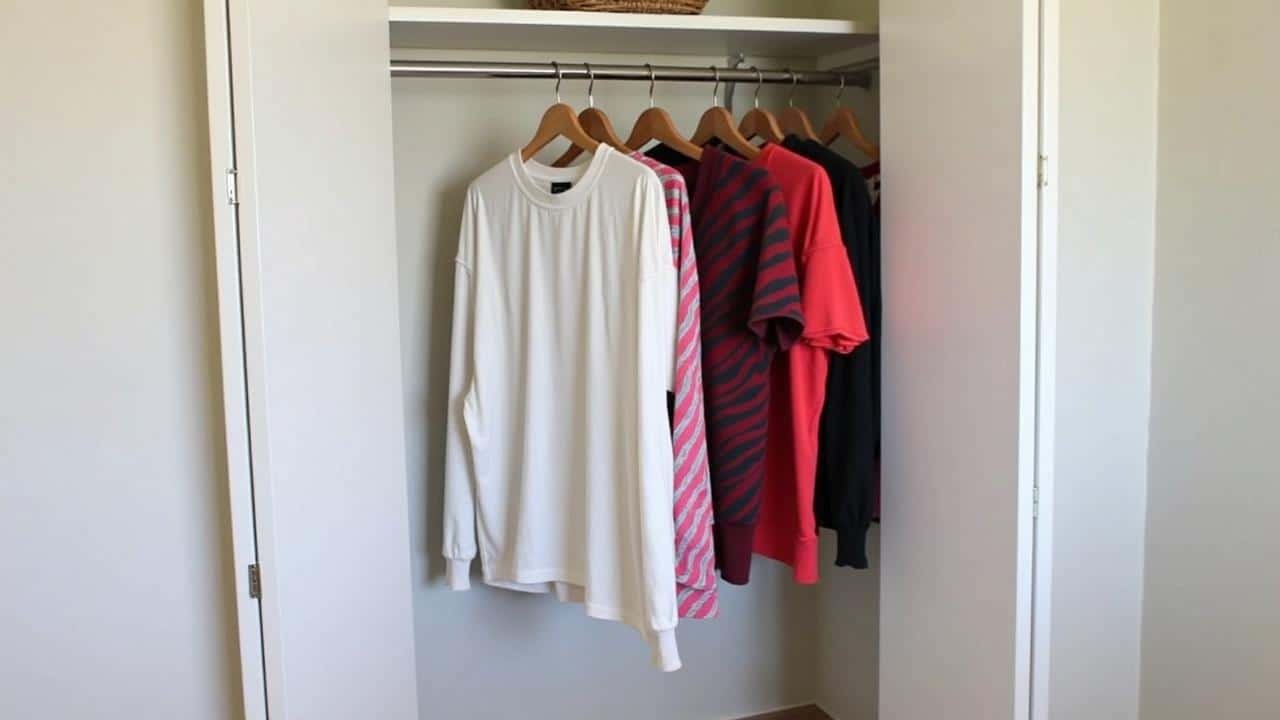
One damp day leads to a chill in your sweaters, then a sour note on a favorite tee. Odors settle in. Fibers feel heavy. And suddenly your wardrobe smells like a basement you never meant to own.

Monday began with a dark sky and a draft that licked the hallway. I slid the closet door and was hit with that quiet, milky smell older houses wear after rain. The linen shirt I wanted felt cold at the cuffs, like it had spent the night by a cracked window, even though it didn’t move an inch. My neighbor Nancy waved from her doorway, hair in a towel, holding a bunch of white chalk tied with twine. She swears it keeps her closet dry, “like a paper bag that never gets soggy.” We laughed, and then I tried it. The fix hangs from a string.
Why clothes get damp in the closet
Closets are air’s cul-de-sacs. Moisture drifts in when you shower, cook, or breathe, then gets trapped behind hanging sleeves and hard walls. The temperature dips at night, and what was just “air” turns clingy. It condenses along back panels and on dense fabrics. That’s the moment odors wake up and stay. The **closet chalk trick** lives here, in the quiet corners where air stops moving, and fibers start drinking.
Think of a narrow wardrobe on an exterior wall. The masonry cools after sunset, so the surface behind your coats becomes a subtle ice pack. A winter coat can hold its own tiny cloud of vapor. Multiply that by denim, flannel, and a wool scarf, and you’ve made a miniature weather system. Hygrometers tucked into closets often show 65–75% relative humidity overnight, while the bedroom might sit at 50–55%. Those extra points are the difference between crisp and musty.

Fibers don’t behave the same way either. Wool and cotton love water molecules; they’re like open hands. Polyester is more guarded, so it stays drier a bit longer. When humidity rises and air can’t circulate, natural fibers soak it up first, then slowly release it back as the day warms. That cycle pulls in odor compounds from skin, fragrance, and dust. If the door stays closed, the microclimate never resets. You’re dressing inside yesterday’s weather.
The simple chalk trick homeowners swear by
Grab 8–12 sticks of plain white school chalk. Tie them with twine or drop them into a breathable pouch—a mesh produce bag or a clean cotton sock works. Hang that bundle from the rail so it sits between garments, not brushing fabric. Chalk is calcium carbonate; it sips moisture from the air without leaving puddles. When the sticks feel soft or look dulled, swap them. You can dry them out on a sunny windowsill and reuse once or twice.
Skip colored chalk. Pigments can transfer, and you don’t want a pink smudge on ivory silk. Don’t bury the bundle behind coats either; it needs a little air to do its job. Rotate it every week or two. If your closet is a serial offender, team chalk with a small tub of baking soda on a shelf, or a pouch of bamboo charcoal. Let’s be honest: nobody really does that every day. Aim for “good enough” and keep it light.

Small moves compound here. Think spacing hangers one finger apart and giving shoes a tray to contain moist soles. That creates breathing lanes for air and limits splash humidity from wet footwear.
“Dry closets are about rhythm, not perfection. A little absorption, a little airflow, and smart placement. That’s it,” says a longtime property manager I met in a rainy coastal town.
- Hang a chalk bundle at eye level, centered, about a palm from fabric.
- Keep a box of **baking soda sachets** on standby for high-humidity weeks.
- Leave the door ajar for 20 minutes after showers or laundry day.
- Refresh absorbers monthly; label the date with a marker.
Keep the habit light, shareable, and yours
We’ve all had that moment when a favorite sweater smells like last week’s weather. You can treat this as home care, but it’s also a little ritual that protects your mood before a big day. A chalk bundle in the closet is almost silly in its simplicity. That’s why it works. It’s light, cheap, repeatable. And it nudges a bigger truth: the house has a climate, and you can tune it.
Try pairing the chalk with a quick airflow habit. Crack the closet door when the bathroom fan runs. Slide hangers so shoulders aren’t kissing. On laundry day, cool your clothes fully before hanging them inside. If you feel ambitious, park a tiny USB fan on a shelf for 30 minutes after a rainy walk home. One minute of attention beats an hour of deep cleaning later. In the background, your wardrobe stops soaking up the room’s mood.
There’s also the quiet pride in a closet that smells like nothing at all. It’s not a candle or a spray doing the heavy lifting. It’s a little science and a string. Share the trick with a roommate, a parent, a friend with a drafty old rental. Call it what it is: everyday weatherproofing for clothes you love. The headline might be chalk, yet the lesson is broader—**airflow matters**, small gaps matter, noticing the room matters. You’ll feel it the next time you slip on a crisp shirt that didn’t drink the rain.
| Point clé | Détail | Intérêt pour le lecteur |
|---|---|---|
| Suspend a white chalk bundle | 8–12 sticks tied with twine, hung between garments | Low-cost moisture control without mess |
| Create breathing lanes | Space hangers a finger apart, keep door ajar after steam | Reduces humidity pockets that cause musty odors |
| Refresh monthly | Replace or sun-dry chalk; rotate absorbers on a schedule | Consistent results with minimal effort |
FAQ :
- Will chalk dust stain my clothes?Use plain white sticks and hang them a palm away from fabric. Dust is minimal and stays on the bundle when not rubbing garments.
- How long does a chalk bundle last?In a typical closet, 4–6 weeks. If sticks feel soft or crumbly, replace or sun-dry and reuse once or twice.
- What if my closet is very damp?Add a sealed tub of calcium chloride on the floor or a small electric dehumidifier. Keep absorbers away from fabrics to avoid spills.
- Is charcoal better than chalk?Bamboo charcoal excels at odor control and some moisture; chalk focuses on moisture. Many people use both for a balanced effect.
- Can I DIY without buying anything?Fill a clean cotton sock with dry rice or baking soda, tie it off, and hang it. It won’t pull as much moisture as silica gel, but it helps.