That everyday pinch where a crease on your collar feels like a loud whisper. There’s a tiny, oddly satisfying fix that lives at your sink, not in your laundry room, and it gets you out the door looking like you meant it.

I watched a friend get ready for a coffee meeting in a studio apartment where the ironing board lived behind a bike and a pile of plants. The shirt was clean, still rumpled, and the clock was disrespectful. She grabbed a spray bottle, filled it from the cold tap, misted the fabric with quick, confident bursts, then pinched and smoothed the cotton as if she were frosting a cake. Two minutes later the shirt hung by the window. While we laced our shoes, the wrinkles let go. Nothing theatrical. Just a quiet reset that felt almost smug in its simplicity. The tag never saw heat. The fibers seemed to sigh. Just cold water.
Why cold water outsmarts everyday creases
Creases are stubborn because fabric remembers. Not in a mystical way, in a physics way. Cloth dries, fibers lock, shapes set. We throw heat at the problem, or stack clothes and hope weight will do the work. The fast lane often sits right between those extremes: rehydrate the fabric lightly, add a hint of tension, and let air finish the job.
Think of a T-shirt that sat at the bottom of a drawer. It’s not dirty, just creased like a folded map. A light cold mist wakes the fibers without stressing them. Your hands smooth, gravity helps, then air does its quiet magic. It’s not wizardry. It’s the same logic as steaming, stripped down to the bare essentials and a kitchen tap.

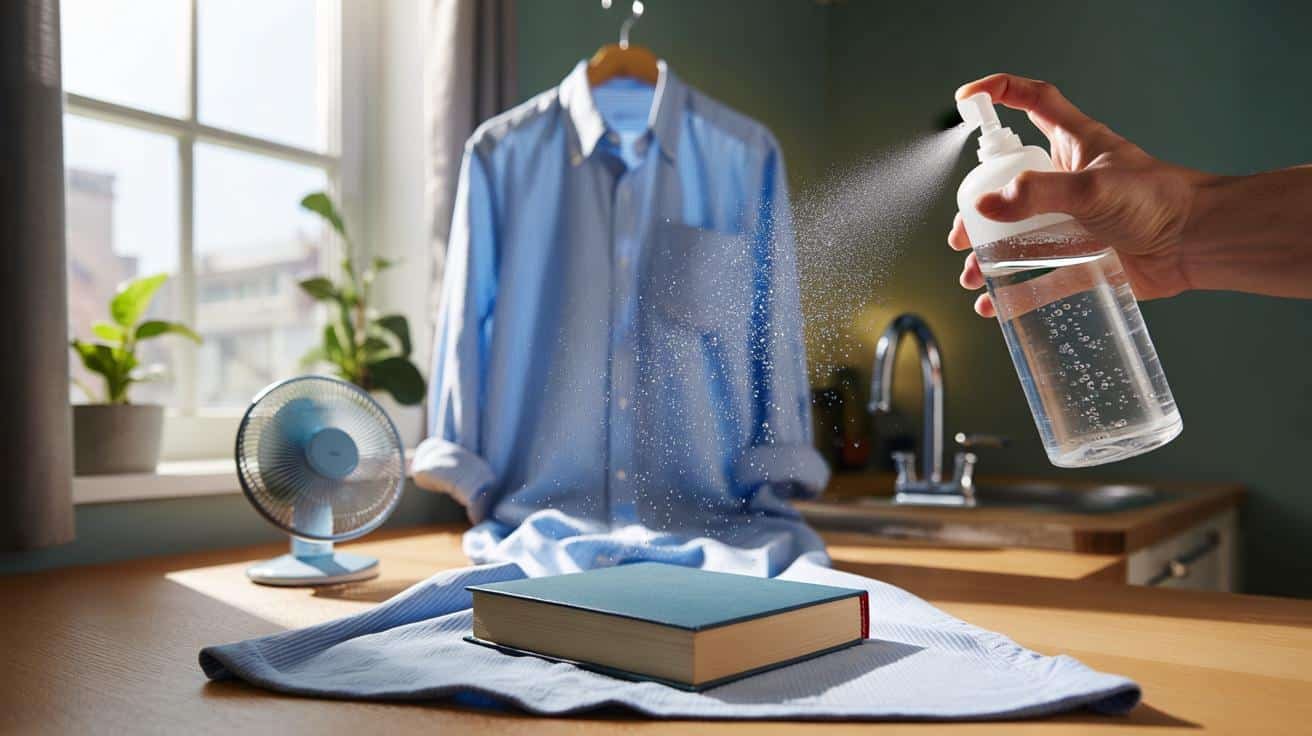
One morning, a neighbor texted from her hallway: “Door is open, the blouse is not.” She had eight minutes, a wrinkled viscose top, and a meeting with her boss. She misted cold water, tugged the shoulder seams, placed the hem under a book for gentle tension, and hung it in front of a fan. By the time her ride arrived, the worst lines were gone. Not glossy and flat like a pressed shirt. Just neat enough to read “put together,” not “rolled out of bed.” The relief on her face? Worth bottling.
Cold water works because of the way fibers bond and release. Many fabrics, especially cotton, linen, and rayon, form hydrogen bonds that decide where a wrinkle sits. A little moisture lets those bonds reorganize. Add light tension and airflow, and the fabric resets in a smoother shape. Heat speeds this up, sure, but it can also over-set a crease or leave shine on touchy materials. Cold water is gentler. You rehydrate the cloth just enough to nudge it. Then gravity, time, and air take the assist.
The cold-water smooth-and-hang method
Here’s the move. Fill a clean spray bottle with cold tap water. Lay or hang the garment so you can reach the wrinkled areas. Mist lightly from 8–12 inches away until the fabric looks cool and slightly darkened, not soaked. Use flat palms to sweep from the center outward, then along seams. Give the hem a little pull. Hang on a broad hanger, and let it dry in moving air—open window, fan, or a breezy doorstep. Most shirts perk up in 10–20 minutes.

You can tweak it. Add a teaspoon of vodka to a cup of water to speed evaporation and kill faint odors. A splash of white vinegar in a 1:4 mix can soften crunchy cotton. For drapey synthetics, go lighter on the spray and lean on gentle hand-smoothing. Test on an inside seam if you’re worried about water spots, especially with silk or cupro. We’ve all had that moment when a beautiful fabric decides to be moody.
Common snags? People over-wet the cloth. A soggy shirt dries slower and can dry into new wrinkles. Mist, don’t douse. Skip wire hangers that create shoulder bumps, and avoid tight bathrooms with no airflow. Let’s be honest: nobody actually does that every day. If time is tight, focus on collar, placket, cuffs, and the chest area—where eyes land first. Tiny wins at the right spot are worth more than perfect creases you’ll hide under a jacket.
Moisture + tension + air = fewer wrinkles. Give the fabric a nudge, then let physics do the heavy lifting.
- Spray: cold water, fine mist, light coverage.
- Shape: smooth with palms, tug seams, weight the hem gently.
- Air: hang in a draft or in front of a fan for a quick dry.
- Skip: leather, suede, and any fabric that water-spots easily.
- Pro touch: roll a towel inside sleeves to keep them round while drying.
A small, repeatable fix with outsized payoff
Ironing isn’t dead. It’s just no longer the default. This trick plants a small habit in that messy gap between laundry day and real life. It’s not perfect, it’s practical. You’re nudging fabric back into shape for a school run, a standing desk shift, or a first date where your shirt should look like it tried. The beauty sits in that low-stress, always-available reset.
Once you see it work, you start spotting moments to use it. The T-shirt that slept in a gym bag. The linen dress that rumpled in a rideshare. The cotton pillowcases that will look nicer tonight if they get a quick mist this afternoon. *Relief, in a spray bottle, is a wild kind of calm.* Share the trick, borrow it back, and keep improvising. Your clothes don’t have to be flawless to read as cared for. They just need a nudge at the right time.
| Point clé | Détail | Intérêt pour le lecteur |
|---|---|---|
| The method | Light cold-water mist, smooth by hand, hang in airflow | A fast, heat-free way to reduce wrinkles on busy days |
| Where it works best | Cotton, linen, rayon/viscose, blends with some natural fiber | Targets the fabrics most likely to look rumpled after storage |
| Time and tools | 10–20 minutes, spray bottle, hanger, optional fan | Low effort, uses what you already have at home |
FAQ :
- Does this replace ironing?For crisp creases and formal shirts, no. For everyday smoothness on tees, blouses, and casual wear, this trick gets you close enough fast.
- Why cold water instead of warm?Cold water rehydrates fibers without risking shine or over-setting creases. You get pliability and control, especially on touchy fabrics.
- Will it work on polyester?It helps a little. Synthetics wrinkle less by nature, but once creased they can be stubborn. Spray lightly, smooth, and use airflow. Results vary by blend.
- Can I add fabric softener or vinegar?A few drops of softener can help with drape; a 1:4 vinegar mix can relax stiff cotton. Test on a hidden spot first to avoid marks.
- What about silk and wool?Silk can spot with water. If you try, mist from farther away and test first. For wool, light mist and palm-smoothing can work, but a steamer or press cloth is safer.